
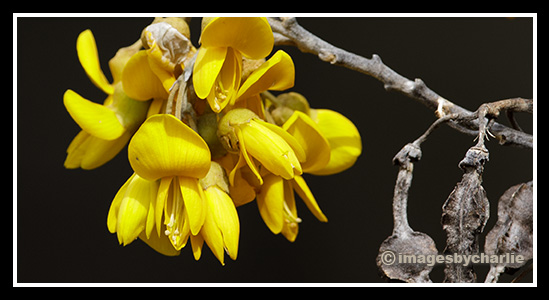
The māmane is an endemic plant in Hawaii that belongs to the pea or legume family (Fabaceae). It has deep green compound leaves (leaves with leaflets attached to the middle vein that have their own stalks) with 6 to10 pairs of leaflets. Yellow pea-like flowers bloom in winter and spring. Māmane grows into bushes and trees at mid to high elevations on Hawaiʻi and Maui. It is rare on Molokaʻi, Oʻahu and Kauaʻi, and believed to be extinct on Lanaʻi. Its conservation status is vulnerable.

Endemic forest birds such as the ʻiʻiwi, ʻapapane and ʻamakihi are often seen feeding on its nectar during flowering season. The brown woody pods are constricted as seen in the photo below.

The palila, the last-remaining endemic honeycreeper with a finch-like bill found only on the Big Island of Hawaii, is dependent on māmane as its main source of food and nesting sites. These birds have adapted to eating the seeds which contain bitter alkaloids that are toxic to other wildlife. According to ecologist Richard Switzer, the birds are critically endangered because māmane trees are being destroyed by livestock. Officials are installing fences to enable māmane to grow back.
 ImagesByCharlie